


New Small Business Lending Rule Undermines Transparency
For Immediate Release: May 7, 2026 Contact: Robert Mayo | hello@woodstockinst.org New Small Business Lending Rule Undermines Transparency The final Section 1071 rule issued by…
MoreAt both the federal and state level, Woodstock Institute works to ensure all communities have access to the financial services necessary for building a strong, local business sector.
Small businesses create economic opportunity within neighborhoods, but access to affordable credit is necessary in order to grow, hire more workers, and make investments that help build wealth within communities. Research shows businesses in low-income communities and communities of color in particular face an uphill battle accessing traditional bank loans, which tend to be more transparent and affordable than loans from nonbank, online lenders.
Woodstock Institute’s Patterns of Disparity: Small Business Lending research series examines small business lending trends across the country to determine the extent to which banks are meeting the credit needs of businesses, to identify racial and economic disparities in access to credit, and to provide policy recommendations for addressing predatory business lending practices.
For example, in Illinois, we found that over a three-year period, businesses located in low-to-moderate income (LMI) census tracts received only 19.3% of bank loans under $100,000 despite making up 27.0% of all Illinois businesses. Making up this deficit would require 46,648 more loans totaling $618 million.
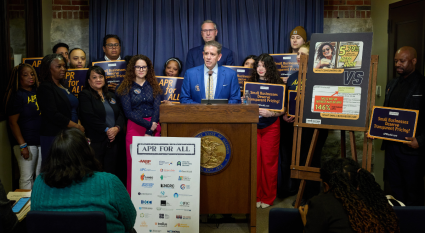
APR For All! As individual consumers, we have long had the right to know the true cost of a loan. We shop for credit cards, car loans, and mortgages based, in large part, on the product’s Annual Percentage Rate (APR). But in Illinois, small businesses are still being kept in the dark. Non-bank lenders are not required to disclose APR.
The Coalition for Small Business Lending Transparency (CSBLT) is a group of small business owners, lenders, nonprofits and advocates working to close this loophole. We believe every entrepreneur deserves the same basic transparency when shopping for financing as consumers have.
Our goal is simple: pass HB744 HA #1, the Small Business Financing Transparency Act (fact sheet available here), in the Illinois General Assembly to require non-bank lenders to disclose APRs to small business borrowers. With transparency, entrepreneurs can make informed decisions, protect their employees and keep wealth in our communities.
Woodstock Institute supports Section 1071 of the Dodd-Frank Wall Street Reform and Consumer Protection Act of 2010, which requires lenders to small businesses to collect their lending data and provide it to the Consumer Financial Protection Bureau (CFPB). The CFPB issued a final rule implementing section 1071 in March 2023, but this has yet to take effect due to both ongoing litigation and legislative efforts to block the rule from taking effect.
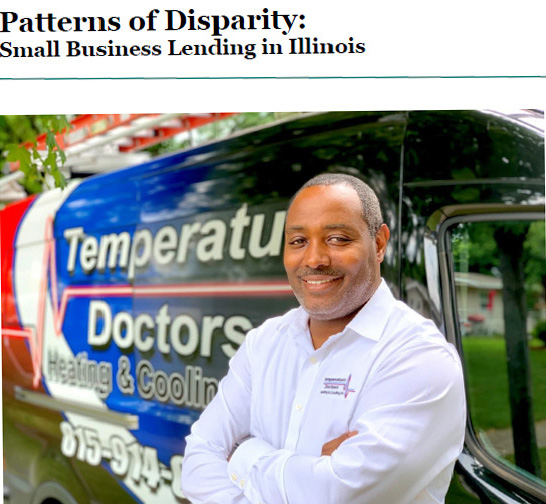
This research series analyzes the small business lending trends in Illinois along with the Chicago, the Los Angeles-San Diego region, Buffalo, New Brunswick, Detroit, Richmond, Fresno, and Minneapolis-St. Paul regions.
Illinois consumers are legally entitled to a variety of protections when they borrow money: lenders must be licensed and they must disclose basic loan terms such as the finance charge expressed as an annual percentage rate or APR.
Small businesses in Illinois have no such protections.